Relaxation Revolution

Is Anxiety Overbreathing?, Breath→Body→Mind, and The Walking Diabetic


Reading Time: 1 min 47 sec

I hope the next 22-ish breaths are the most nourishing of your day.


4 THOUGHTS

1. The Key to Breath-Linked Mind Control

“Research where people consciously change their breathing rates has shown that different ways of breathing can encourage particular frequencies to dominate across the brain, which can take us to a more alert and focused state or to a more relaxed and drowsy one. There’s only one catch…breath-linked mind control only works if you breathe through your nose.

- Caroline Williams, Move

Nothing to add to this one 😊

2. The Breath->Body->Mind Pathway

“If mind and body are one, we can do more than change the body by changing the mind; we can change the mind by changing the body.”

- Ellen Langer, Ph.D., The Mindful Body

Although Dr. Langer wasn’t referring to breathing, this principle has been demonstrated perfectly in breath research.

A 2002 study found that emotional states produce similar breathing patterns across people. Remarkably, the opposite was also true: breathing in specific patterns can induce specific emotions.

In other words, we can influence how we feel by changing how we breathe…we can “change the mind by changing the body.”

3. What if Anxiety is Partially Just Over Breathing?

Anxiety isn’t just in your your. It may also be worsened overbreathing.

Here’s how it works:

  1. When we breathe too much, CO₂ drops.

  2. When CO₂ drops, cerebral blood flow drops.

  3. When cerebral blood flow drops, anxiety gets worse.

Slow breathing—when done correctly—helps interrupt that loop.

If you’d like the blueprint and reference sheets on how to do it right, check out The Anxious Person’s Breath Manual.

P.S. Physiology is always more complex than a single sentence. But the CO₂–brain blood flow relationship is so robust that researchers even quantify it: For every 1 mmHg decrease in arterial CO₂, cerebral blood flow reduces roughly 2%. Pretty crazy.

4. The Walking Diabetic

“Another beautiful thing about walking is that it doesn’t require a membership, a monthly pass or a sign-up sheet. Simply put on your shoes and walk out the door.”

- Libby DeLana, Do Walk

Some days, I consider rebranding myself as “The Walking Diabetic” (or “The Reading Diabetic” 😂). But in the end, they’re all part of the same practice.

So this is our friendly reminder to get out and move to complement our meditative practices.


1 Quote

Because all health conditions have some stress component, it is no overstatement to say that virtually every single health problem and disease can be improved with a mind body approach.”
— Herbert Benson

1 GOOD BOOK

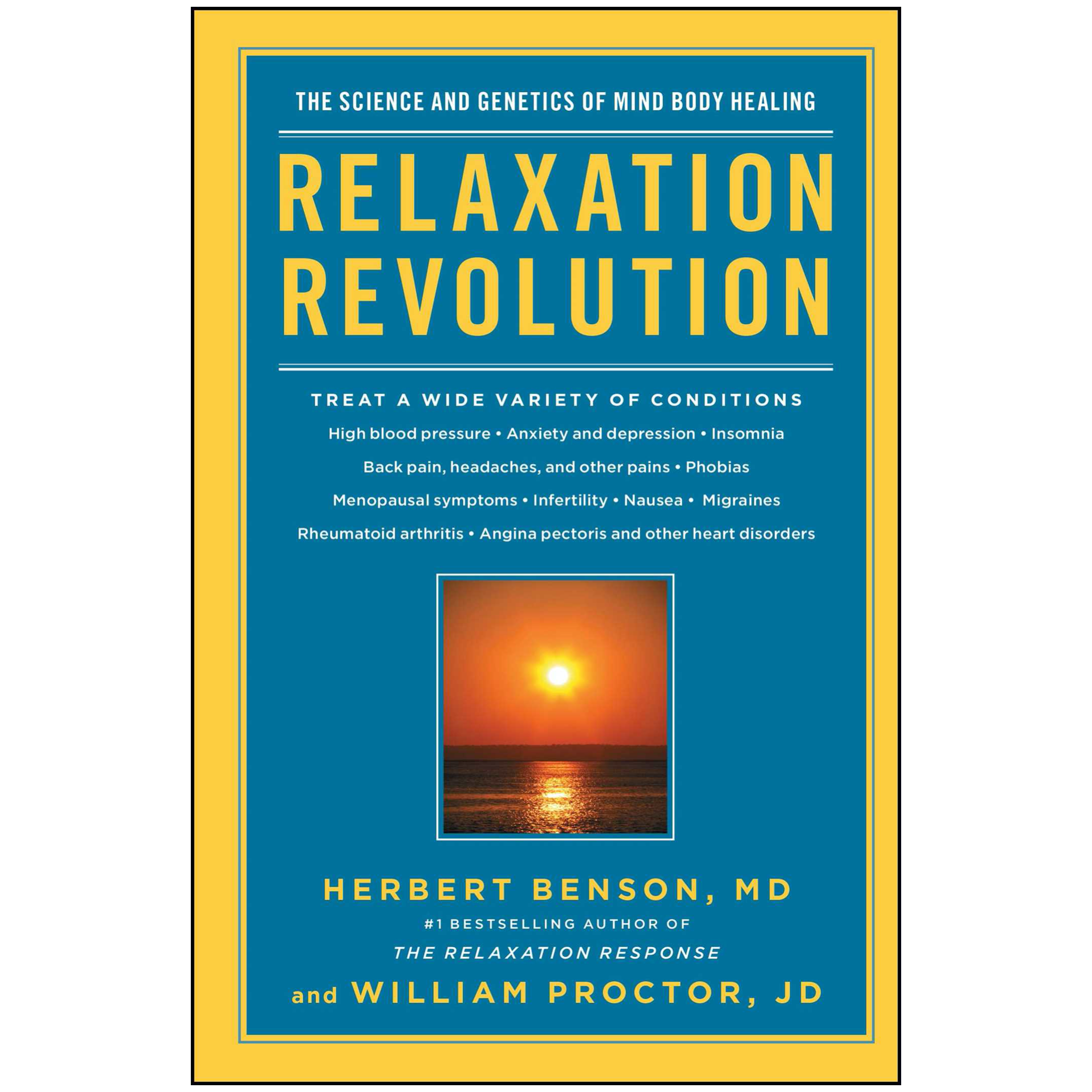
Relaxation Revolution by Herbert Benson, MD

A foundational book in the mind–body world, providing the science and stories on how the relaxation response heals.

In good breath,

Nick Heath, T1D, PhD
“Breathing is the compound interest of health & wellness.”


P.S. no thanks, I’m trying to cut back
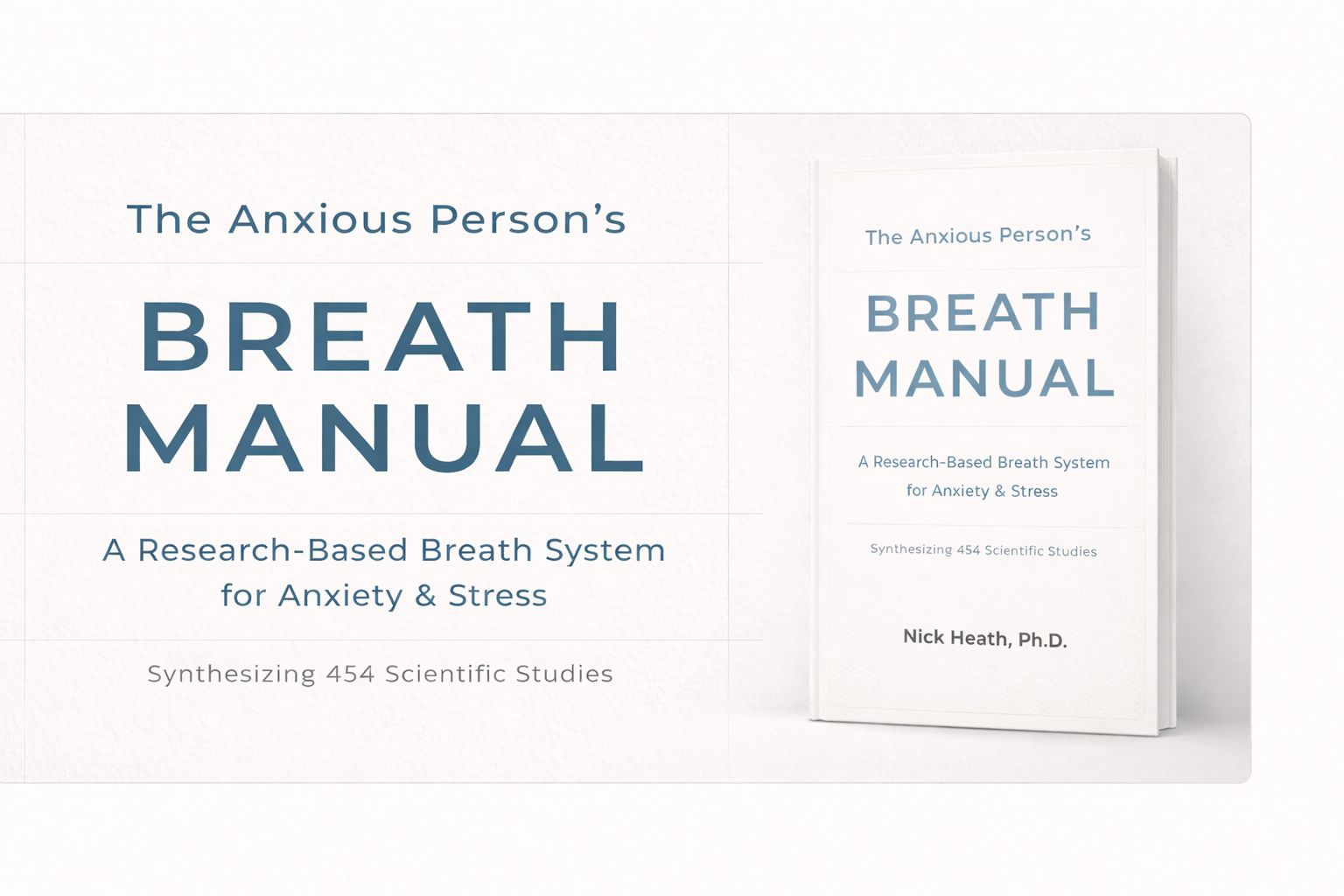

Synthesizing 454 studies to provide a structured, research-based breath system for regulating anxiety at the nervous system and brain levels.

Get it today.


Amazon Associate Disclosure

I’ve been recommending books for almost 6 years. Yet somehow, I just discovered that I could be an Amazon affiliate [face-palm]. In any case better late than never. Now, any Amazon link you click is an affiliate link. As an Amazon Associate, I earn from qualifying purchases. So, if you’d like to support my work, buying books through these links is helpful : )

* An asterisk by a quote indicates that I listened to this book on Audible. Therefore, the quotation might not be correct, but is my best attempt at reproducing the punctuation based on the narrator’s pace, tone, and pauses.



How to Be Irreplaceable, Coffee or Breath, and the Most Important Study Yet


Listen Instead of Reading

If you enjoy listening, you can subscribe to the audio version on Spotify, Apple Podcasts, and Audible so you don’t even have to look at the email 😊


4 Thoughts


1. Breathwork for Stress: The Most Important Paper To Date

“Research on breathwork could be likened to that of meditation, which received an unprecedented surge in scientific exploration two decades ago. We may be at a similar cusp with breathwork and anticipate considerable growth in the field.”

 - Nature Scientific Reports (2023)


IMHO, this is the most important breathing publication to date. Nothing is perfect, but this is a meta-analysis of randomized controlled trials—basically the best scientific analysis that can be performed.

It’s a mind-blower…here are a few key takeaways:

  • Breathwork is as effective as cognitive behavioral therapy (CBT), meditation, mindfulness, and acceptance of emotions for reducing stress.

  • Breathwork is as effective as physical exercise for reducing anxiety and depression symptoms.

  • Whether breathwork is self-learned remotely, taught 1-on-1, or taught to a group doesn’t impact the above results.

I have a new Science 411 with all the details, if you’re interested. If you sign up, I highly recommend the 17-min podcast version because I add a lot of context, which is too much for written form.

2. A Humble Reminder for Thought 1

“Many ancient practices and rituals have been rejected by modern science, only to be resurrected from the grave by that same science!”

- Herbert Benson, MD, Relaxation Revolution

Let’s not forget that, although modern science is powerful, breathing exercises have something even more potent behind them: thousands of years of practice.

3. Coffee or Breathwork? Here’s My Lighthearted Take On It

“By replacing your morning coffee with breathwork, you can lose up to 87% of what little joy you still have left in your life.”

I’m late with this joke, but I recently saw that sentence (with green tea instead of breathwork), and I thought it was amazing.

Personally, I don’t plan on replacing my coffee with breathing. Of course, there’s nothing wrong with doing that; I just love coffee.

Instead, I think of my morning breathing as a no-sugar coffee creamer. It makes my coffee that much better, with no blood sugar spikes : )

4. A Tiny Thought On Methods (a play on a Thich Nhat Hanh quote)

Breathing methods come and go like clouds in the sky. Principles are my anchor.


Want to Become a Unique and Irreplaceable Breath Coach?

It takes just 30 minutes a week.

Here’s exactly how.


1 Quote

Here, the need for healing was not synonymous with brokenness. It was part of life.”
— Lisa Miller, Ph.D.

1 Answer

Category: Alveoli

Answer: These holes allow communication between two adjacent alveoli.

(Cue the Jeopardy! music.)

Question: What are the Pores of Kohn?


In good breath,

Nick Heath, T1D, PhD
“Breathing is the compound interest of health & wellness.”


P.S. SECRETS TO SUCCESS


How Focus Words and Breathing Can Help You Relax and Heal

I recently wrote a guest blog for ResBiotic on focus words and breathing. It includes 7 steps for using the relaxation response in your life. Enjoy!


* An asterisk by a quote indicates that I listened to this book on Audible. Therefore, the quotation might not be correct, but is my best attempt at reproducing the punctuation based on the narrator’s pace, tone, and pauses.


Sign Up For The Breathing 411

Each Monday, I curate and synthesize information from scientific journals, books, articles, and podcasts to share 4 thoughts, 1 quote, and 1 answer (like "Jeopardy!") related to breathing. It’s a fun way to learn something new each week.


My New Favorite Therapy, Self Love, and Your Breathing Headphones


Listen Instead of Reading

If you enjoy listening, you can subscribe to the audio version on Spotify, Apple Podcasts, and Audible so you don’t even have to look at the email 😊


4 Thoughts


1. Reading Can Produce Healing (my new favorite word & therapy)

“Bibliotherapy is based on the assumption that the simple act of reading can produce healing of various health conditions, including depression. The definition of bibliotherapy has broadened over the years to include using any type of reading material that is uplifting or emotionally sustaining.”

 - Herbert Benson, MD, Relaxation Revolution


As someone obsessed with reading, bibliotherapy might be my new favorite word and therapy : ) However, I’ve always thought that reading alone is not enough; we must also act. 

Maybe I’m wrong…

As Dr. Benson says, one study found “Therapeutic reading ranked toward the top of the interventions, along with CBT and supportive-expressive groups, as a highly effective method of decreasing depressive symptoms.” <— 🤯

I hope these 411s serve as bibliotherapy for you 🙏

2. The Relaxation Response for Stress-Related Diseases

“Taken together, the RR has been shown to be an appropriate and relevant therapeutic tool to counteract several stress-related disease processes and certain health restrictions, particularly in immunological, cardiovascular, and neurodegenerative diseases/mental disorders.”

Esch et al. (2003)

This study found that regularly eliciting the relaxation response can counter the adverse effects of stress and serve as a free therapeutic tool in many chronic diseases, especially immunological, cardiovascular, and neurodegenerative/mental disorders.

Want to use it in your life? Here’s a short video showing you how.

***

P.S. If you want to use the relaxation response to conquer stress, check out the latest Science 411 on this paper or the new Book 411 on Relaxation Revolution, released this past Friday.

3. Breathing as Spiritual Headphones

Breathing exercises are like spiritual headphones: You can tune in, not bother anyone, and no one will ever know what you’re “listening” to.

4. Breathing is Self-Love, a Pre-Requisite for Loving Others

Last week, we learned that high vagal tone = high loving potential; thus, slow breathing increases our loving potential.

But the key word there is “potential:”

“While these activities do not directly create positivity resonance, they can set the table for an eventual feast of love. … They condition your mind, heart, eyes, and ears to be more prepared for positivity resonance when true connections become possible.

- Barbara Fredrickson, Ph.D., Love 2.0

So, we might say that a daily breathing practice is self-love, which prepares your heart and mind to love others.


1 Quote

We must meet hate with love. We must meet physical force with soul force.”
— Martin Luther King, Jr.

1 Answer

Category: Stress

Answer: When free radical production exceeds antioxidant defenses, it creates this kind of stress.

(Cue the Jeopardy! music.)

Question: What is oxidative stress?

P.S. The relaxation response helps counter this stress, too.


In good breath,

Nick Heath, T1D, PhD
“Breathing is the compound interest of health & wellness.”


P.S. I’ve been really missing my friends


* An asterisk by a quote indicates that I listened to this book on Audible. Therefore, the quotation might not be correct, but is my best attempt at reproducing the punctuation based on the narrator’s pace, tone, and pauses.


Sign Up For The Breathing 411

Each Monday, I curate and synthesize information from scientific journals, books, articles, and podcasts to share 4 thoughts, 1 quote, and 1 answer (like "Jeopardy!") related to breathing. It’s a fun way to learn something new each week.


3 Healing Breaths, a Celebration, and a Thought Experiment


Listen Instead of Reading

If you enjoy listening, you can subscribe to the audio version on Spotify, Apple Podcasts, and Audible so you don’t even have to look at the email 😊


A Celebration (sort of)

Today marks 24 years with type-1 diabetes. Not exactly the present I wanted from Santa. But it was exactly what I needed to become the person I was meant to become.

My parents were obviously devastated. But, this did have an upside—they gave me some early presents 😂 😂 😂


Me in the hospital at age 11.


P.S. HOmm HOmm HOmm

Alright, on to this week’s 411…


4 Thoughts


1. Why Mind-Body Therapies (like breathing) Seem Like a Panacea: Part 3

A certain mind body treatment may help hypertension, depression, or insomnia. At the same time, this treatment will counter the overall physical and mental manifestations of stress through the calming of brain activity and altering hormones and gene expression. The mind body treatment performs particular, reductionistic functions on specific health complaints and at the same time tends to the health of the entire biological system.” (my bold)

- Herbert Benson, MD, Relaxation Revolution

That’s incredibly powerful. It means we can use breathing for our individual needs (diabetes, for me) while strengthening all other aspects of our health at the same time. Quite panacea-ish, indeed 😊

P.S. Here are Part 1 and Part 2.

2. An Inverse Thought Experiment

Think of a time you got really mad or frustrated for a very brief period. Did it actually end when it ended? Or were you upset for another hour? Maybe the rest of the day?

OK, this is exactly how slow breathing works, just opposite. It’s a brief period of calm that lingers just like a brief period of anger does.

The difference: It’s easy to see how anger ruins our day, but sometimes harder to notice how a breathing practice brightens it.

3. Three Healing Breaths You Can Start Using Today

If you’d like to get all of the most powerful practices, guidelines, and science from one of the best breathing books, The Healing Power of the Breath, check out the Book 411 I just released on it.

It has everything you need to use their approach for better health.

Join the Learning Center for the full review. In the meantime, here are 3 core healing breaths from the book you can start using today:

1. Coherent Breathing® is taught as breathing at a rate of 5 breaths a minute with a 6-second inhale, and a 6-second exhale. “Coherent Breathing … calms the mind, slows the heart, lowers blood pressure, reduces inflammation, and strengthens stress resilience.

2. Resistance Breathing is any technique that adds resistance to our breath. They have two practices for this, ujjayi (or ocean breath) and pursed-lips breathing: “Whether you choose to make a sound in the back of your throat like the ocean or to use pursed lips to create resistance to the flow of air, your practice of Resistance Breathing can amplify the benefits of Coherent Breathing.

3. Breath Moving:Breath Moving entails moving the breath in circuits to different parts of the body, moving upward on the inhale and downward on the exhale. … [It]…can be used to elevate energy as well as to relieve pain.

(All above quotes come from the authors, Richard Brown, MD, and Patricia Gerbarg, MD.)

4. Study

Rather than study every aspect of life, we can study the breath, which can be applied in every aspect of life.


1 Quote

Breathing involves a continual oscillation between exhaling and inhaling, offering ourselves to the world at one moment and drawing the world into ourselves at the next.
— David Abram
 

1 Answer

Category: Oxygen Transport

Answer: Hemoglobin molecules have this many binding sites for oxygen molecules.

(Cue the Jeopardy! music.)

Question: What is four?


For Therapists: Anicca Wellness

What if you can stay in sync with your breath, wherever you are, no matter what you are doing?

- Edo Ceder, Anicca Wellness Co-Founder

If you’re a therapist, check out this opportunity to incorporate breathing into your practice using Anicca Wellness. One of the co-founders, Edo, is a 411 subscriber, friend, and just a genuinely good person.

I hope you’ll check it out.


In good breath,

Nick Heath, T1D, PhD
“Breathing is the compound interest of health & wellness.”

P.S. I used to think adulthood was…

P.P.S. A Secret Breathing Santa


* An asterisk by a quote indicates that I listened to this book on Audible. Therefore, the quotation might not be correct, but is my best attempt at reproducing the punctuation based on the narrator’s pace, tone, and pauses.


Sign Up For The Breathing 411

Each Monday, I curate and synthesize information from scientific journals, books, articles, and podcasts to share 4 thoughts, 1 quote, and 1 answer (like "Jeopardy!") related to breathing. It’s a fun way to learn something new each week.


Neat Breath Science, 3 Sentences to Live By, and it is a Panacea


Listen Instead of Reading

If you enjoy listening, you can subscribe to the audio version on Spotify, Apple Podcasts, and Audible so you don’t even have to look at the email 😊


4 Thoughts


1. Neat Science: How to See If Slow Breathing is an Antioxidant

…our results lead to the hypothesis that slow breathing may exert some antioxidant effect, possibly via parasympathetic stimulation.

- Nature (2017)

The way they got to this hypothesis was pretty cool:

  1. They had people with type-1 diabetes inhale extra oxygen.

  2. After, they observed that arterial stiffness and blood pressure went up. This was likely due to excess oxidative stress.

  3. Then, they repeated the process, but participants breathed slowly at 6 breaths/min while inhaling oxygen.

  4. Slow breathing offset the harmful effects of extra oxygen on blood pressure and arterial stiffness.

Together, this suggests that slow breathing acts as a natural antioxidant.

***

P.S. If you want more neat findings like this, check out the Science 411s in the Breath is Life Learning Center.

2. Get 90% from 50% (or less): A Few Minutes Go a Long Way

As you read any given sentence, you will probably get 90% of the meaning from 50% of the words…the rest of the words are unnecessary filler.

- Peter Hollins, The Science of Self-Learning

This made me think of how, with breathing, we get a lot of psychological benefits from a small percentage of the breaths we take.

Example: A 20-minute morning breath practice might be less than 1% of your breaths. But, it may account for 90% of your equanimity.

Of course, all our other breaths aren’t just “fillers”—they’re critical to our wellness, too. But let’s remember that even a small investment in our breath can go a long way toward our health and happiness 🙏

3. Why Breathing Seems Like a Panacea: Part II

In fact, any condition that is caused or exacerbated by stress can be helped by a well-designed mind body approach. Furthermore, because all health conditions have some stress component, it is no overstatement to say that virtually every single health problem and disease can be improved with a mind body approach.” (my bold)

- Herbert Benson, MD, Relaxation Revolution

Slow breathing is one of the fastest and most effective mind-body approaches to triggering the relaxation response and reducing stress.

And since stress plays a role in basically every health condition, breathing can therefore help in basically every health condition.

Breathe slowly—> reduce stress—> improve virtually every health condition. Maybe it is a panacea, after all? 😊

***

P.S. See Thought #1 here for Part I.

4. Three Short Ancient Sentences to Live By

Walk slowly! Talk little! Love breath!

- The Primordial Breath, Volume I

Sounds like a perfect life-mantra to me 🙏


1 Quote

And beyond improving stress resilience, breath practices can restore your sense of being genuinely who you are, of knowing what you feel, of recognizing what others feel, and of being able to experience deep and meaningful connections with people, with your values, and with all that is.
— Richard Brown, MD, and Patricia Gerbarg, MD
 

1 Answer

Category: The Cardiovascular System

Answer: There are approximately this many miles of veins, capillaries, and arteries in an average adult.

(Cue the Jeopardy! music.)

Question: What is 60,000 miles?


In good breath,

Nick Heath, T1D, PhD
“Breathing is the compound interest of health & wellness.”

P.S. Every. Single. Time.


Breath is Life Learning
Science and Books Made Simple

For each book and research paper I read, you get an easy-to-digest 411 summary:

  • Web-based text or downloadable PDF

  • Audio podcast version (also downloadable)

Plus, you get a super short daily email with a nugget of breathing wisdom. It only takes a few seconds to read, but it will set you up for a better day, every day.

P.S. 30-Second Science

For each Science 411, if you read the “1 Big Takeaway” followed by the “1 Practical Application,” you can get almost everything you need from a study in about 30 seconds.

P.P.S. Life-Changing Ideas

For each Book 411, you get “1 Life-Changing” idea from that book. Thus, even if you’re not interested in the book, you can open that section and get a quick idea to help you live a better life.

Here are a few of my favorites:

  • From Buddha’s Brain: Our Breath Moves Spirit Around Like Our Hearts Move Blood Around

  • From The Mindful Day: How to Live Longer (regardless of your age, lifespan, or healthspan)

  • From Breath by Breath: How it Should Be, and Letting Breath (and life) Unfold Naturally

  • From The Confidence Gap: No One is Perfect (and the solution)

  • From Stolen Focus: Mind-Wandering is a Superpower (and How to Do It Correctly)


* An asterisk by a quote indicates that I listened to this book on Audible. Therefore, the quotation might not be correct, but is my best attempt at reproducing the punctuation based on the narrator’s pace, tone, and pauses.


Sign Up For The Breathing 411

Each Monday, I curate and synthesize information from scientific journals, books, articles, and podcasts to share 4 thoughts, 1 quote, and 1 answer (like "Jeopardy!") related to breathing. It’s a fun way to learn something new each week.


Breathing and Brushing Your Teeth

 
bernard_berenson_consistency.png
 

I’m pretty obsessive about my breathing practice and I tend to over-analyze every session. “Why did it feel harder today? Was I breathing light enough? I need to increase my CO2 more…” It goes on and on.

Recently, however, I heard something awesome in a “+1” from Brian Johnson. He quoted a great passage from Herbert Benson in The Relaxation Revolution:

Most of us are concerned to one extent or another with dental hygiene, but we don’t dwell on the tooth-cleaning process. We just work away with that brush every day. Almost no one evaluates the brushing, to say, “That was a good brush!” or, “Too bad—that was a bad brush.” We simply do it!”

I love that. When is the last time you analyzed your tooth brushing skills? Probably never. Yet, we count on it for dental hygiene. We trust that it’s working, whether we brush “good” or not.

In some ways, that’s what we have to do with our breathing practice. (Or any integrative health practice, such as meditation, yoga, or physical exercise.)

We can’t spend too much time worrying if we did it exactly right. Instead, we just have to do it. Every day. And know that it’s working.

Of course, we want to start with the right principles and not jump foolishly into something. But, once we’ve committed, sometimes we just have to trust the process without over-analyzing it.

Here’s to treating our breath/meditation/yoga practice more like brushing our teeth.

In good breath,
Nick

P.S. Here’s another gem from Herbert Benson on the same topic (my bold for emphasis):

“Similarly, if you’re taking a pill your doctor has prescribed for your cholesterol or blood pressure, you probably don’t wonder, “Am I putting this pill in the proper side of my mouth? Am I swallowing it correctly? Is it really going to work?” Again, you just do it—and that should be your approach to mind body treatments.